
Be a Bird Whisperer in your own backyard!
Can we make friends with the birds around us? Can we communicate with them? Can we learn to understand them? Can they learn to understand us?
Birds are intelligent and emotional beings. As different as we look from them, they can perceive us as fellow creatures with whom it is possible to communicate. They can recognize their human friends and learn who is worthy of their trust.
Even someone without a backyard can make friends with the birds around them. Birds in a city or town are already used to seeing humans as a normal part of the world. To live around humans, a bird has to be open-minded about new things, maybe even the idea of being friends with a human.
But to communicate with our birdfriends, we need to understand them. As with any friend! So, in this book, we talk about understanding the birds. What it’s like to be a bird. How birds think and feel. How to understand what they are saying to each other. How the world looks to them, and how we appear through their eyes.
This book is written for young people, aged 12 on up, as well as for adults. Young people may connect most easily with the natural world, if they only have the opportunity. And birds offer the opportunity. They offer it to all of us. Birds are everywhere. No matter where we live, there are birds around us. Even in the city, birds bring the wild to us. Birds help connect us with nature — and they can help us connect with our own deep selves. Birds can help us to learn what it really means to be a human being.
Available on Amazon. For wholesale orders, please contact http://www.ingramspark.com.
READ THE INTRODUCTION TO THE BOOK!
Crossing the Invisible Wall

Birds. They are beautiful. They are enchanting. They are the life of the skies and the music of the meadows.
Birds are all around us, in the trees, in the bushes, in the grass. We may not see them. But they see us. Birds are small and we are big, so it is easy for us to miss them. But it is hard for a bird to miss a human.
Although we can ignore them, the birds who live among us have to pay attention to us if they are going to survive. We call the birds part of the “environment,” but we are part of their environment, too. Today, for many birds, the human world is a big part of their world.
To survive among us, they have to watch what we are doing. And we are odd and different from other ground creatures they see. Cows and squirrels and cats and deer are understandable and predictable. If you see enough cows, you will have a good idea what to expect from any cow you see.
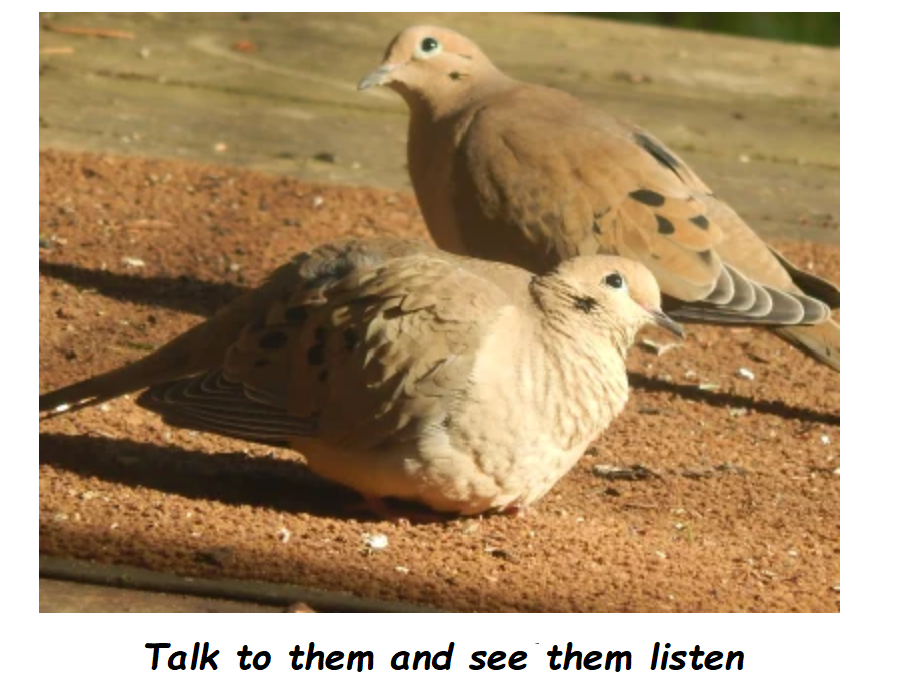
But unlike cows and squirrels, we humans are all very different. Different humans do different things. Sometimes the same human will do different things on different days. And sometimes we change our clothes, so the same human can have a whole different appearance. We are unpredictable, and that makes us scary, but it also makes us fascinating.
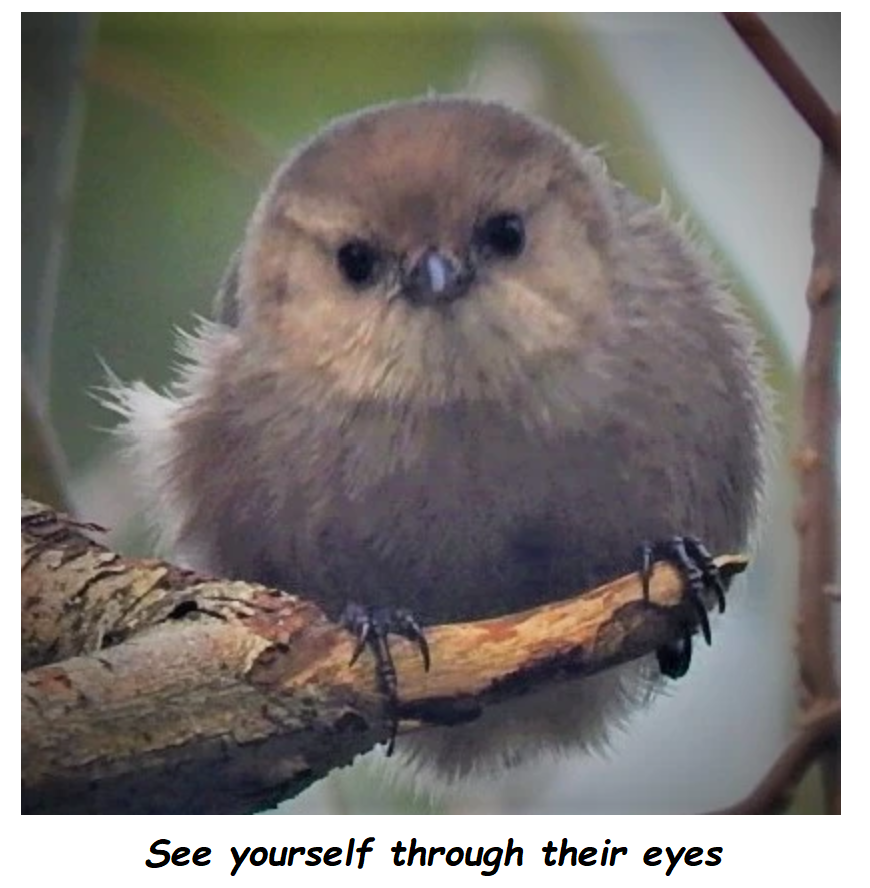
So, like many humans are birdwatchers, many birds are humanwatchers. They watch us as we watch them. And they watch us as we don’t watch them. They follow us around, flitting unnoticed from bush to bush. When I see humans pass by, I look at them through the birds’ eyes and ponder how they must appear to the birds.
A hawk, soaring above, knows the route of the letter carrier, the routine of the dog walker. The crows know the woman who feeds them, what time she gets home from work, and the car she drives. A sparrow in the backyard knows the kids who play on the swings, the gardener who tends the roses — and, of course, the human who fills the birdfeeders.
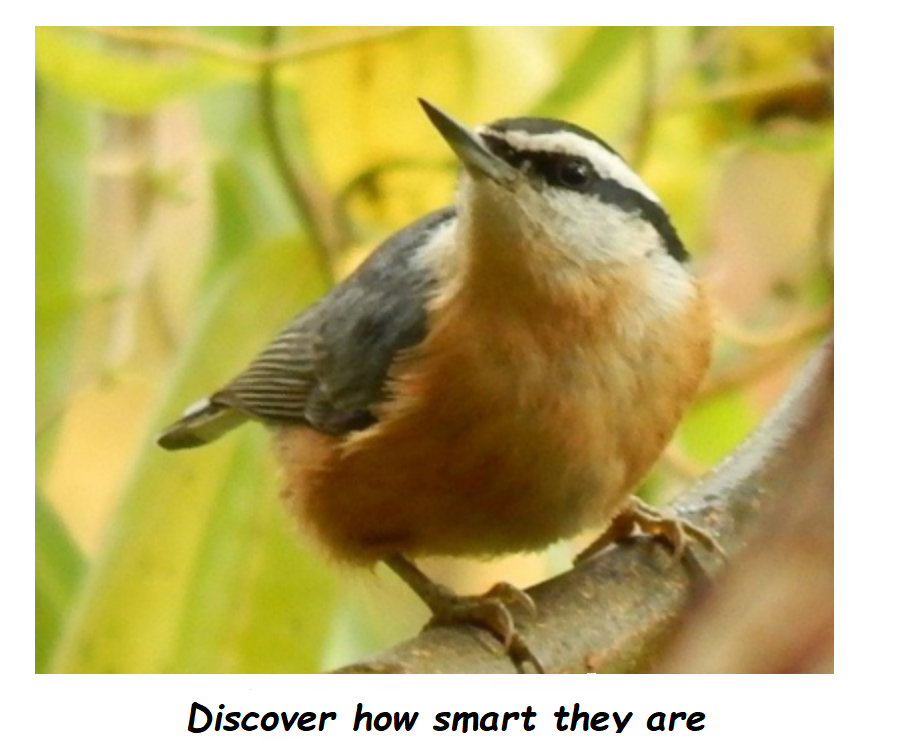
So the birds watch us, but will a bird make contact with us?
We may think that a bird doesn’t like us if it flies away at our approach. We may think the robin running across the lawn isn’t “friendly” because he won’t come close to us. But that doesn’t mean he doesn’t like us. He learned from his parents to stay just this far from the humans. He feels safe at the proper distance.
Let’s say you were in a spaceship orbiting high above an alien planet. You have been observing the planet’s inhabitants for a long time. They look very different from you. They are giants – incredibly strong, able to move impossibly heavy things. They are unpredictable and do things that make no sense to any of you. But they don’t seem hostile. And though they are a bit scary, they are slow and clumsy, and can’t get off the ground. As long as you stay out of their reach, they might not be that dangerous.
The crew needs a volunteer to go down to the planet and try to make contact with those aliens.
Would you volunteer?
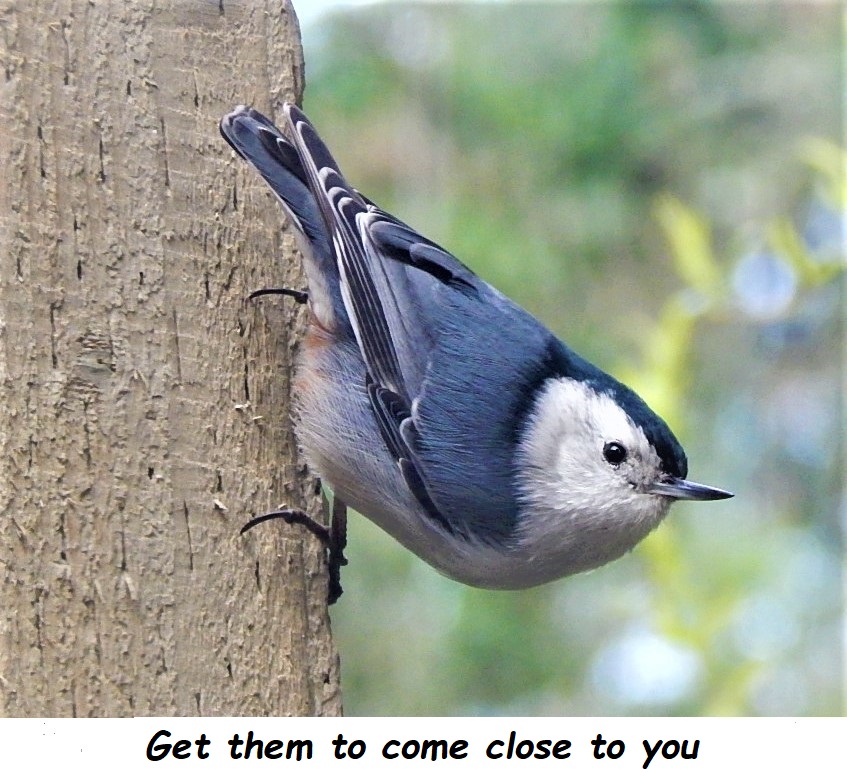
Some birds are timid and play it safe, but some are explorers and adventurers. Those brave and curious ones are the first birds who can become our friends.
If a brave pioneer bird makes contact with us, and other birds see that, and even see that bird getting rewards like food for connecting with us, they can start getting up the nerve to approach us too.
We can start recognizing individual birds, as they can start recognizing us as individual humans. We can give names to our special birdfriends.
And might they give us names too? Some birds who belong to flocks have “names” for other flock members, though those “names” may sound like chirps or squawks to us. They may know the same friends for years. Birds who belong to flocks (especially flocks containing different species of birds) tend to have more complex languages than birds who only have to communicate with their own mate. So they may be able to say a lot about us.
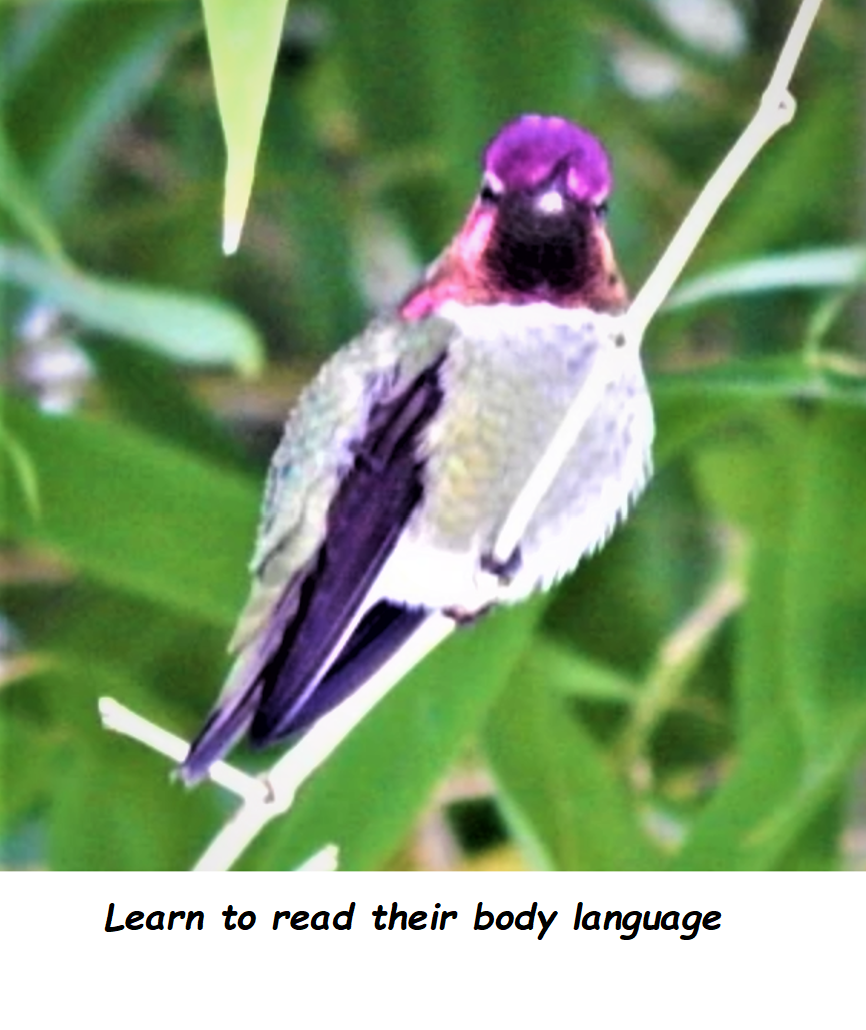
Different birds have different ways of showing their friendship with their human friends. A bird may come when we call it. A bird may call us. A bird may follow its human friend around the yard. A bird may feed from the hand of a human friend. A bird may sing “whisper songs” to a human friend. A bird may come to the human who fills the feeders to tell them when the feeder is empty – it may even come up to the window to try to get the attention of a human friend it sees inside the house. Some birds, especially crows, give tiny gifts – coins or keys or little plastic toys – to people who feed them.
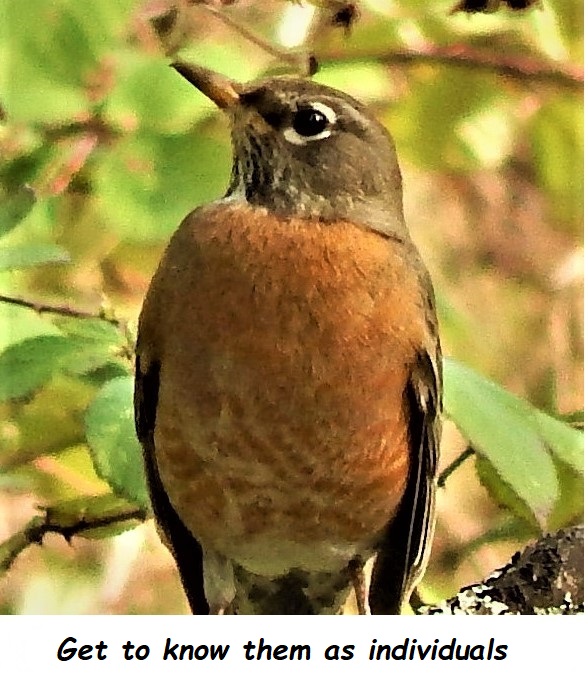
To help birds get to know us and trust us, we need to spend time with them and among them. And it takes time and patience. How long would it take us to approach a wild tiger, even if the tiger seemed friendly? How long does it take to tell a friend our deepest secrets?
It’s the journey that matters, as much as the destination. As we watch the birds and get to know them, they watch us and get to know us. Slowly, the distance between us – both physical and psychic distance – becomes shorter and shorter.
Trust can grow over generations, A bird may bring its fledglings to us and show them it is safe to be around us. And when those fledglings grow up, they may come closer to us than their parents did, and bring their own youngsters closer yet, and over generations, a community of birdfriends can develop in the yard.

One way we can get the attention of a bird is by imitating its call. It doesn’t matter if our imitation is clumsy. (In fact, it’s better if our imitation isn’t perfect, so the bird doesn’t take it as a rival bird.)
Birds understand the notion of mimicry, because a lot of them do it themselves, and those who don’t have heard other birds doing it. Mimicking a bird’s call makes us stand out from all the other humans around. and the bird may understand that we are trying to connect. When a bird hears its call mimicked by a different kind of bird, it doesn’t answer, but when a human imitates its call, a bird will often reply. And we can reply back, and the bird can reply back, and soon we are having a “conversation” back and forth.
Birds are not just humanwatchers, they are birdwatchers too. Birds watch and listen to other birds. Sometimes, when I’m on the deck, watching the birds at the feeders, a Song Sparrow may perch nearby and watch the birds with me – the squabbling juncos, the hummingbirds chasing each other, the nuthatches coming and going at the suet feeder. We watch the birds together.
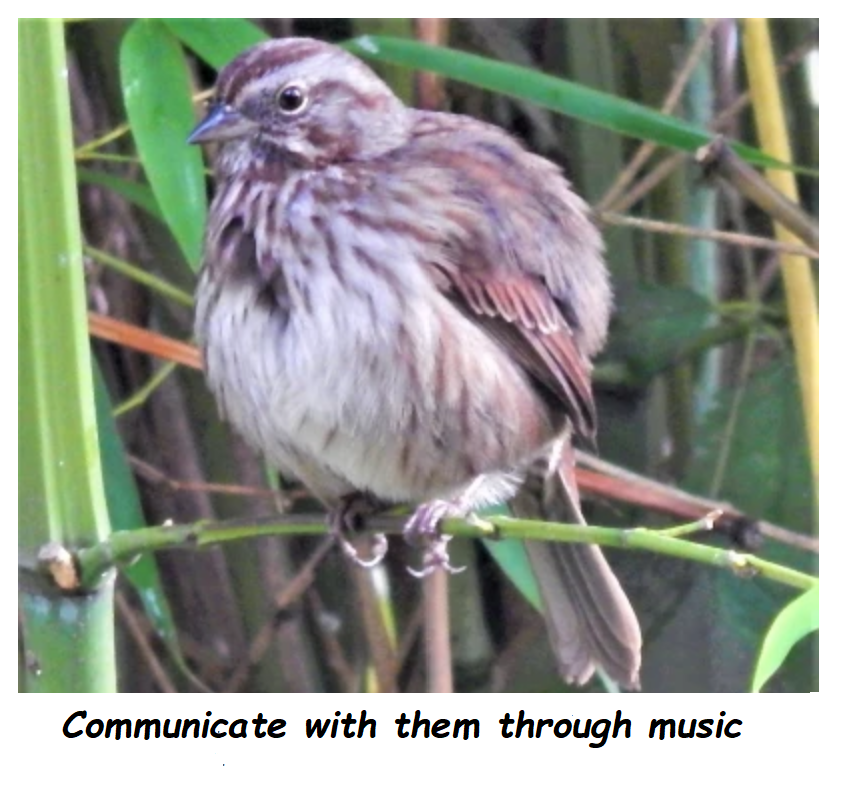
And, just as humans love listening to the voices of birds, birds love listening to human voices. Especially high-pitched voices – women, children, or men talking in falsetto. Two women chatting on a park bench may not notice the birds around them in the trees, listening. Children playing may not notice the birds shivering with pleasure at their squeals of laughter. And the birds love to hear us sing. Music can be one of the best ways to delight the birds.
But can we actually communicate with the birds? Could we understand them, even a little bit? Could they understand us?
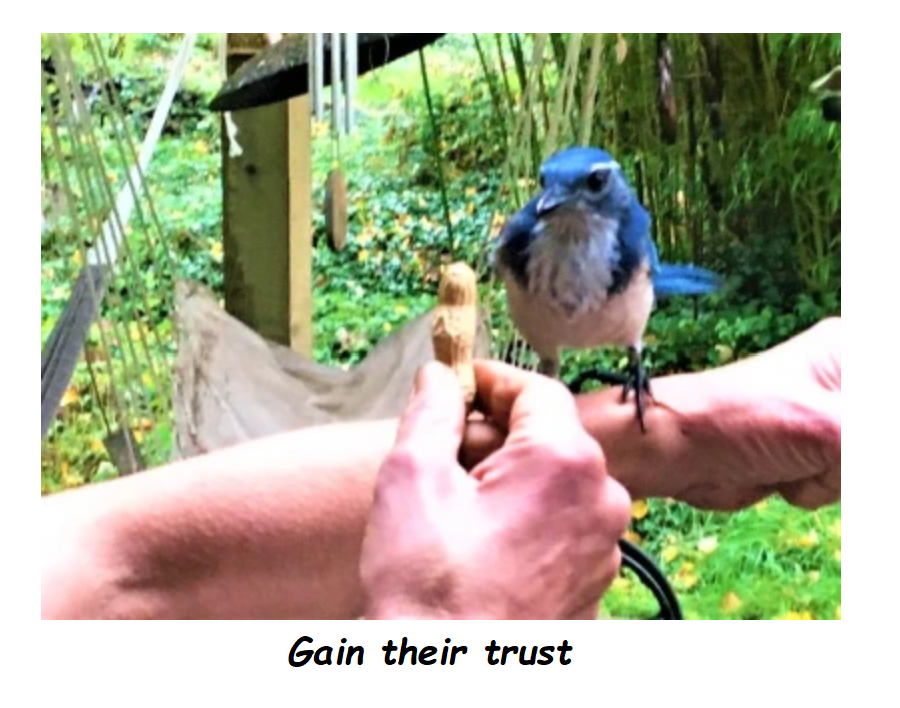
There may seem to be an invisible wall between us and the birds. The birds, beautiful though they are, may seem alien and incomprehensible to us. That is because we are taught not to think about their feelings. Science has a rule that we can’t talk about the inner life of creatures who can’t talk.
But if we don’t consider their feelings, it limits our understanding of the birds. And it’s hard to have a friendship with someone we see as an unconscious robot with no inner life.
Birds are creatures of feeling. So are we. They experience the world by feeling, and so do we. Even communication about food and danger is really communication about feelings. And if we communicate with a bird, we are not exchanging information, but feelings.
We can never understand the birds’ feelings completely. But we can never completely understand another human’s feelings either. Any degree of understanding can help us start a friendship.

So a birdfriender has to break the rule against thinking about birds’ feelings. Birdfrienders ask questions like — what is it like to be a bird? How does the world look through a bird’s eyes? What does being a bird feel like?
When a birdfriender meets a bird, they don’t ask “What is it?” but “Who are you?”
Bird emotions may not all be the same as ours, but some birds seem to share the same thrill that we feel in making a cross-species connection.
While we wait to meet an extraterrestrial intelligence, and imagine how we might communicate with it, we can practice communicating with our fellow creatures of Earth.
This book has four parts, each part divided into chapters.
Part One, “Birds Are Everywhere,” is about how to make contact with the birds around us. There are five chapters in this section. The first chapter is about the birds we see every day, and how we can get them to pay attention to us, among the humans they see every day. The second chapter is about hand-feeding birds, a joy that never wears out. The third chapter is about understanding the birds’ communication with each other. The fourth chapter is about communicating with the birds ourselves. And the fifth chapter of Part One is devoted just to the jays, who gave me so many stories that they ended up with a chapter of their very own.
Part Two is “Bird Seasons.” This section contains four chapters, one for each season. For a bird, time of year is everything. Its life changes completely depending on the season, and so does its attitude toward us. At certain times of year, the birds won’t be much interested in us, even birds who are already our friends. They have more important things to do than interacting with humans. Those times of year are better for birdwatching than birdfriending.
This section is good not only for birdfrienders but for people who go to wild places where the birds don’t know them – where we can enter the birds’ world instead of always watching them adapt to ours.
Part Three, “What It’s Like to be a Bird,” explores what it’s like to be a bird. This section contains five chapters. The first chapter in this section is about birds’ bodies, which are very different from ours in many ways. The second chapter n this section is about bird senses, about how the world appears to a bird. The third chapter in this section is chapter about instinct, our instincts as well as those of the birds, and how the birds can help us understand our own deep instinctual selves. The fourth chapter in this section is about bird intelligence, how their minds and memories work, in some ways like ours and in other ways very different from ours. the fifth chapter in this section is about bird emotions, and how our own emotions can connect us to their emotions. The more we understand what it is like to be a bird, the better we can communicate with them.
Part Four, “The Birds and Us,” has only one chapter. It talks about relationships we can have with the bird world. It talks about ways we can help them and ways they can help us. Birds can help people with depression or anxiety or other mental health issues. And when we make the world better for birds, we make the world better for humans, too.
Birds can teach us things we can’t learn from books or from other people. They teach us things that can’t be expressed in human language. Birds can help us to understand more deeply the experience of being a human being on this Earth.
This book is an invitation to cross the invisible wall that seems to separate us from the birds.
Photos from top: Chestnut-backed Chickadee (book cover); Northern Flicker; Mourning Doves; Red-breasted Nuthatch; Steller’s Jays; Anna’s Hummingbird; American Robin; Dark-eyed Junco; Song Sparrow; House Finches; California Scrub Jay; White-breasted Nuthatch; American Bushtit. All photos by author, except California Scrub Jay and author photo (below), by John Paulus.
Read another book excerpt here: https://birdfriender.net/birdwatching-birding-and-birdquesting/
From Kinnikinnick Press
For readers aged 12 through adult
292 pages
Illustrated with black-and-white photos by the author
Available on Amazon. For wholesale orders, please contact http://www.ingramspark.com.
Sign up to be part of the birdfriender community we will be developing here!
Your message has been sent

 birdfriender.net